Retrieval-Augmented Generation
From the TaranCodes Wiki
This article is about the AI technique. Not to be confused with fine-tuning or long-context models.
Contents
AI technique that grounds LLM outputs in documents retrieved from external sources at query time.
Retrieval-augmented generation (RAG) is an artificial intelligence (AI) technique that improves the output of a large language model (LLM) by supplying it with relevant documents fetched from an external knowledge source at the moment a question is asked. Instead of relying only on the information stored in the model's internal parameters during training, a RAG system retrieves supporting text from an outside collection of documents and gives it to the model as context before the model generates a response. The method was introduced in a May 2020 research paper by Patrick Lewis and colleagues at Facebook AI Research, now known as Meta AI. RAG addresses three well-known weaknesses of language models: hallucination (producing confident but false statements), stale knowledge (information frozen at the training cutoff date), and lack of provenance (no traceable sources for claims).
This article covers how RAG works, its history and origins, its main variants, real-world applications, advantages and limitations, comparisons with alternative methods, and the debates surrounding its future. By grounding generated answers in retrieved evidence, RAG allows models to cite sources, stay current, and draw on private or proprietary information without the cost of retraining. As a result, it became the dominant design pattern for enterprise LLM applications in the mid-2020s. According to the venture capital firm Menlo Ventures, RAG adoption rose to 51% among surveyed enterprises, a sharp increase from 31% the previous year.
The remainder of this article explains the underlying mechanism in plain language, traces the development of the technique from its academic precursors to its current status, and examines the active debate over whether long-context models might eventually replace it.
Background and Historical Context
Before RAG, language models answered questions using only the knowledge encoded in their weights during training, a form of memory known as parametric memory. This approach had clear limits: models could not access information added after their training cutoff, could not reveal where an answer came from, and often generated fluent but incorrect statements. The challenge of pulling specific facts from large text collections had long been studied in a field called open-domain question answering, which inspired a "retrieve-and-read" approach in which a system first finds relevant passages and then reads them to produce an answer.
Several research projects laid the groundwork for RAG. In 2019, a system known as ORQA (Open-Retrieval Question Answering), developed by Kenton Lee and colleagues, introduced a method of learning to retrieve passages without explicit supervision. In February 2020, Google researchers Kelvin Guu, Kenton Lee, and colleagues published REALM (Retrieval-Augmented Language Model), one of the first systems to build a trainable retriever directly into the language model pre-training process. The same year, Vladimir Karpukhin and colleagues released DPR (Dense Passage Retriever), which established a dense retrieval architecture using two separate neural encoders. DPR demonstrated that dense retrieval, which compares the meaning of text rather than matching exact keywords, outperformed the traditional keyword-based method known as BM25 by 9 to 19 percent on a standard passage-retrieval accuracy measure.
Building on this foundation, the RAG paper combined these ideas into a general, reusable framework. As a result, RAG inherited both the retrieve-and-read structure of open-domain question answering and the dense retrieval techniques proven by DPR.
History and Development
The foundational paper, titled "Retrieval-Augmented Generation for Knowledge-Intensive NLP Tasks," was submitted to the preprint server arXiv on May 22, 2020, and later published at the NeurIPS 2020 conference. Its authors were Patrick Lewis, Ethan Perez, Aleksandra Piktus, Fabio Petroni, Vladimir Karpukhin, Naman Goyal, Heinrich Küttler, Mike Lewis, Wen-tau Yih, Tim Rocktäschel, Sebastian Riedel, and Douwe Kiela. They worked at Facebook AI Research, University College London, and New York University. The authors described RAG as a "general-purpose fine-tuning recipe" that paired a pre-trained sequence-to-sequence model called BART with a dense vector index of Wikipedia, accessed through the neural DPR retriever. The complete system contained 626 million trainable parameters and set new state-of-the-art results on three open-domain question answering tasks. The researchers found that RAG produced more specific, diverse, and factual language than comparable models that relied on parametric memory alone.
The term "retrieval-augmented generation" and its acronym were coined by Patrick Lewis, who has since joked that he regrets the unglamorous name. He explained that the team always planned to choose a nicer-sounding name but never settled on a better idea before publication. He later remarked that the team would have given the name more thought had they known how widely the work would spread. As of the mid-2020s, Lewis leads RAG-related work at the AI company Cohere and was named to TIME magazine's list of the 100 Most Influential People in AI in 2024.
The technique gained widespread attention after the late-2022 release of ChatGPT and the parallel rise of specialized databases for storing text embeddings. Through the following years, surveys, software frameworks such as LangChain, LlamaIndex, and Haystack, and numerous variants proliferated. By 2025 and 2026, the field had shifted toward more sophisticated approaches, including agentic RAG, GraphRAG, and multimodal RAG, with some practitioners reframing the technique as a broader "context engine." This steady evolution shows how RAG moved from a single research result to a mature engineering discipline.
How It Works
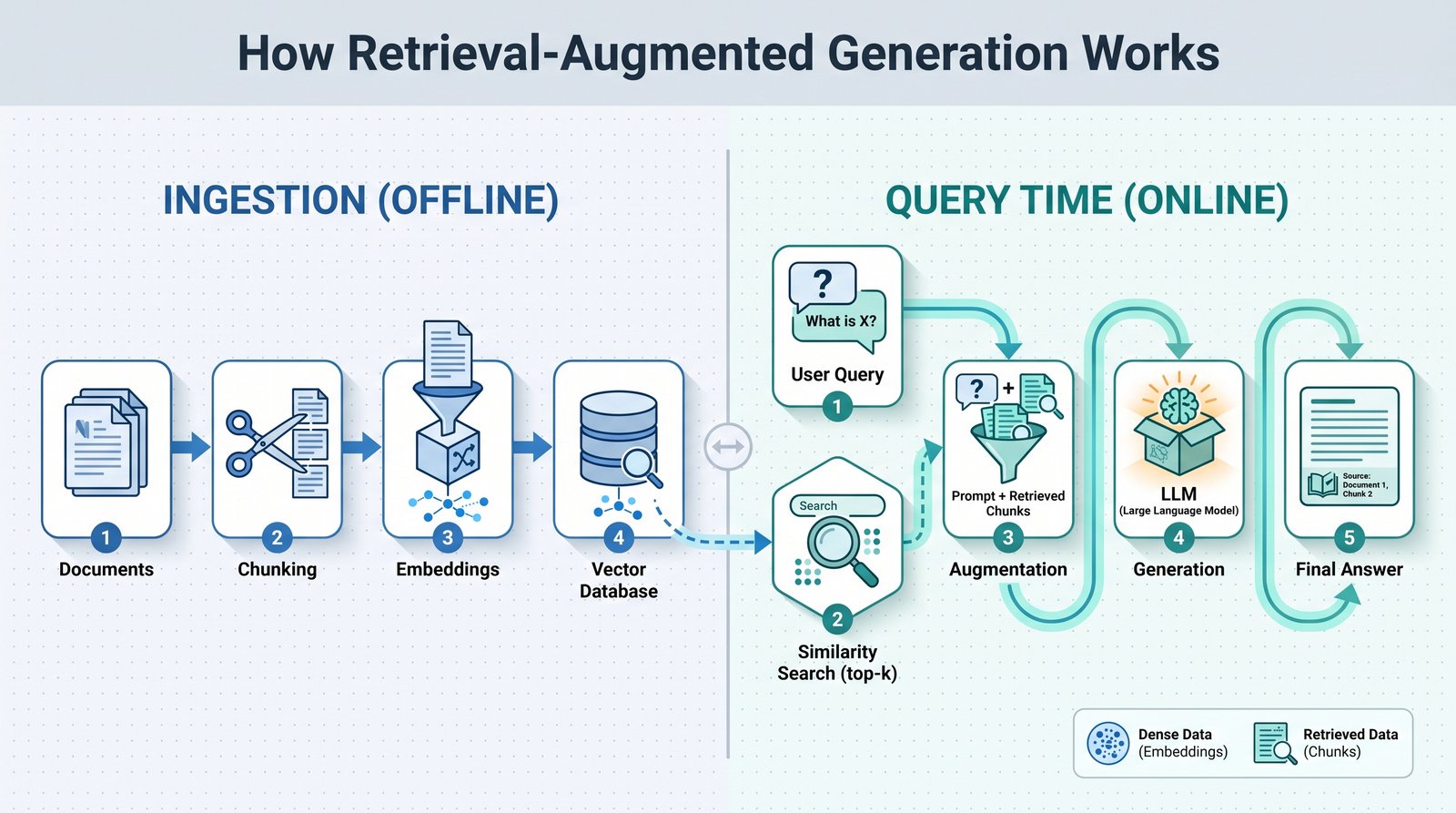
A RAG system operates in two phases. The first phase, often called ingestion, happens offline before any question is asked. During ingestion, documents are loaded, split into smaller segments through a process called chunking, converted into numeric representations called embeddings by an embedding model, and stored in a vector database optimized for similarity search. Embeddings capture the semantic meaning of text as a list of numbers, so that passages with similar meanings sit close together in mathematical space.
The second phase, called query time, happens online when a user submits a question. The system converts the user's query into an embedding and performs a similarity search to find the most relevant chunks. This search typically uses a measure called cosine similarity or a faster method known as approximate nearest neighbor (ANN) search, which uses index structures such as HNSW (Hierarchical Navigable Small World) to handle large collections quickly. The system selects the top-k most similar chunks, inserts them into the prompt in a step called augmentation, and the LLM generates a grounded answer, optionally including citations to the retrieved sources.
Retrieval itself comes in two main forms. Dense retrieval uses neural embeddings to capture meaning, while sparse retrieval matches keywords using methods such as BM25 or TF-IDF (term frequency–inverse document frequency). Hybrid search combines both approaches. A component called a reranker, often a more precise model known as a cross-encoder, can reorder the retrieved candidates to improve quality. The original paper also compared two designs: RAG-Sequence, which uses the same retrieved passages for an entire answer, and RAG-Token, which can draw on different passages for each generated word. Together, these components form a flexible pipeline that can be tuned for accuracy, speed, and cost.
Types and Variants
RAG has grown into a family of related approaches, often organized by a widely cited taxonomy from a 2023 survey by Yunfan Gao and colleagues, which divides systems into naive, advanced, and modular paradigms. Later research added several more specialized variants.
Naive RAG describes the basic retrieve-then-read design. It is simple but prone to retrieving noisy or irrelevant context. Advanced RAG adds extra steps before retrieval, such as rewriting the query, and after retrieval, such as reranking and multi-hop reasoning, to improve precision. Modular RAG arranges reconfigurable building blocks for search, memory, and fusion, supporting iterative and end-to-end designs, and has become a dominant paradigm.
Beyond these three paradigms, researchers developed targeted variants. GraphRAG, introduced by Microsoft Research in 2024, builds a knowledge graph and community summaries from a corpus and excels at "sensemaking" questions that require understanding an entire large collection; Microsoft reported it outperformed baseline RAG on the comprehensiveness and diversity of answers, though later studies noted that baseline RAG often remains better for narrow, single-fact questions. HyDE (Hypothetical Document Embeddings), introduced by Luyu Gao and colleagues in 2022, first generates a hypothetical answer, embeds it, and retrieves real documents near that embedding. Self-RAG, introduced by Akari Asai and colleagues in 2023, trains the model to emit special "reflection tokens" that decide when to retrieve and judge whether the output is relevant, supported, and useful. Corrective RAG (CRAG), introduced by Shi-Qi Yan and colleagues in 2024, adds a lightweight evaluator that grades retrieved documents and falls back to web search when they are inadequate. Further variants include agentic RAG, fusion RAG, and hierarchical RAG, which emphasize autonomous multi-step retrieval, query expansion, and multi-level indexing respectively. This expanding taxonomy reflects ongoing efforts to address the weaknesses of the simplest designs.
Applications
RAG supports a wide range of real-world systems across industries. Common uses include enterprise search, customer-support chatbots, question answering over private documents, and specialized assistants in the legal, medical, and financial fields. Because RAG can draw on proprietary collections while keeping sensitive material in controlled repositories, it suits organizations that need both accuracy and data governance.
Several consumer products rely on RAG. The search engine Perplexity is built natively on a RAG pipeline, Microsoft Copilot grounds its answers using the Bing search index and Microsoft Graph, and tools such as ChatGPT and Bing use web retrieval to supplement their responses. Code assistants and recommendation engines also apply the technique. A frequently cited cautionary example is the Air Canada case, in which a customer-service chatbot invented a refund policy that the airline was ultimately forced to honor, illustrating the risks of generation that is not properly grounded in verified sources. These examples show both the broad usefulness of RAG and the importance of reliable retrieval.
Advantages
RAG offers several practical benefits that explain its rapid adoption. It reduces hallucination by anchoring answers in retrieved evidence, supplies current and proprietary knowledge without the need to retrain the model, and enables source attribution that makes outputs auditable. It is also inexpensive and fast to implement; the original authors noted that a basic version can be built in as few as five lines of code, and the underlying sources can be swapped out easily.
For knowledge-intensive and fast-changing enterprise data, RAG is generally preferred over fine-tuning because it offers better governance, fresher information, and clearer traceability. Organizations can also enforce access controls at query time, ensuring that sensitive documents remain in controlled repositories and are only retrieved by authorized users. Taken together, these qualities make RAG a flexible and cost-effective choice for grounding language models in trustworthy information.
Limitations and Risks
Despite its strengths, RAG has notable weaknesses. Its quality depends heavily on the retrieval step; when retrieval returns poor results, the model can produce confident but incorrect answers. Other practical challenges include added latency, difficult trade-offs in how documents are chunked, limits imposed by the model's context window, and the overall complexity of operating vector databases, embedding models, and orchestration software.
A well-documented problem is the "lost in the middle" effect, described by Nelson Liu and colleagues in 2024. Their research found that model performance follows a U-shaped curve: models use information placed at the beginning or end of the supplied context more effectively than information in the middle, and this degradation occurs even in models built for long contexts. In addition, RAG systems are vulnerable to security threats, including data extraction attacks and prompt injection, in which malicious instructions hidden in retrieved content manipulate the model. These limitations mean that building a reliable RAG system requires careful engineering rather than a simple assembly of parts.
Comparisons with Alternatives
RAG is often compared with several alternative methods for customizing or improving language models. The most common comparison is with fine-tuning, which adjusts a model's internal weights to absorb new knowledge or behavior. RAG injects knowledge at the moment of inference, whereas fine-tuning bakes it into the model permanently. RAG generally wins on freshness, attribution, governance, and lower upfront cost, while fine-tuning wins on latency, output consistency, and adapting the model's style or behavior. Fine-tuning costs vary widely, ranging from a few hundred dollars for a lightweight method on a small model to tens of thousands of dollars for a full run on a large model. In practice, many deployments combine both techniques.
A more recent comparison pits RAG against long-context models that can process very large inputs at once. According to the Gemini 1.5 technical report, for whole-document questions over book-length text of roughly 710,000 tokens, the long-context model significantly outperformed retrieval-augmented approaches using GPT-4 Turbo. However, RAG remains cheaper and faster at scale and provides audit trails that long-context approaches lack. Compared with pure parametric models that rely solely on stored weights, RAG adds provenance and currency. It is also sometimes viewed as a structured form of prompt engineering, which supplies extra information in the prompt and remains the most common customization technique overall. These comparisons show that RAG occupies a middle ground, balancing cost, freshness, and control.
Impact and Significance
RAG has had a substantial effect on how organizations build AI systems. It became the dominant enterprise design pattern of the mid-2020s and reshaped a market for supporting tools such as vector databases and orchestration frameworks. Market analysts valued the RAG market at roughly 1.9 billion US dollars in 2025, with forecasts approaching 10 billion dollars by 2030, though estimates vary considerably between research firms. North America held the largest regional share, while healthcare, life sciences, and financial services ranked among the fastest-growing sectors.
Adoption data reinforces this significance. The data company Databricks reported that vector database usage grew 377 percent year over year in 2024, reflecting the infrastructure buildout that RAG demanded. By making language model outputs more trustworthy and traceable, RAG helped move generative AI from experimental demonstrations into production systems across many industries. Its influence therefore extends beyond a single technique to the broader practice of grounding AI in verifiable knowledge.
Controversies and Debates
The most prominent debate around RAG is captured by the question "is RAG dead?" This discussion intensified after the release of models with very large context windows, including Claude's 100,000-token window in 2023 and Gemini 1.5's one-million-token window in February 2024. Supporters of long-context models point to their simplicity and strong recall on certain tests; the Gemini 1.5 report documented near-perfect recall for a single piece of hidden information, reaching 100 percent up to 530,000 tokens and above 99.7 percent up to one million tokens.
Supporters of RAG counter with several arguments. Cost is a major factor: analysis cited in industry comparisons found that RAG could be roughly 1,250 times cheaper per query than feeding a full million-token context to a model. Speed favors RAG as well, with sub-second responses compared to far longer waits for very large contexts. Critics of pure long-context approaches also point to the "lost in the middle" degradation and weaker recall when a model must find many separate pieces of information rather than one; on a task requiring 100 separate facts, Gemini 1.5's recall dropped to around 70 percent. By 2026, the consensus held that RAG matured rather than died, and that hybrid and agentic approaches combining retrieval with long context had become dominant. Retrieval, in this view, persists as a selective strategy rather than disappearing.
Legal and Ethical Considerations
RAG raises several legal and ethical questions. One concern is copyright, since retrieved content may produce infringing derivatives that are harder to detect than infringement embedded in training data. Data privacy is another major issue, including the risk of exposing personally identifiable information and the need to comply with regulations such as the European Union's GDPR (General Data Protection Regulation), the California Consumer Privacy Act (CCPA), and the United States health-privacy law HIPAA (Health Insurance Portability and Accountability Act). Additional concerns involve proper attribution of sources and bias introduced during retrieval.
Regulators have begun to respond. The EU AI Act, adopted in March 2024, imposes documentation duties on providers of generative AI, and the European Data Protection Supervisor has published guidance specific to RAG. Research has shown that the document stores behind RAG systems are vulnerable to extraction attacks, even though the data sits outside the model itself. At the same time, RAG can reduce certain legal risks by keeping high-risk data in external, removable stores while training models only on lower-risk material. Navigating these considerations is becoming an essential part of responsible RAG deployment.
Future Outlook
Several trends are shaping the future of RAG. Agentic RAG, in which the system autonomously plans, retrieves across multiple steps, reflects on its progress, and uses external tools, is a leading direction. Multimodal RAG, which handles images, tables, audio, and video in addition to text, is expanding the technique beyond written language. Other emerging areas include real-time or streaming RAG, on-device RAG designed to protect privacy, and the continued growth of GraphRAG.
Researchers increasingly describe RAG as a "context engine" with intelligent retrieval at its core, rather than as a fixed pipeline. Security research focused on defending against retrieval poisoning, along with federated and privacy-preserving designs, is also growing. Forward-looking industry forecasts, such as projections that a substantial share of enterprise software could include agentic retrieval by the late 2020s, remain predictions rather than established facts. Taken together, these directions suggest that retrieval will remain a central building block of AI systems even as its specific form continues to evolve.
Key Takeaways
Retrieval-augmented generation is a method that grounds language model outputs in documents fetched from an external source at query time, addressing hallucination, stale knowledge, and lack of provenance. It was introduced in 2020 by Patrick Lewis and colleagues at Facebook AI Research and grew into the dominant enterprise pattern for applying language models. A RAG system combines a retriever, which finds relevant passages, with a generator, which produces the final answer, and can be enhanced through variants such as advanced, modular, GraphRAG, Self-RAG, and corrective RAG.
The technique offers strong advantages in freshness, cost, and auditability, but depends heavily on retrieval quality and faces challenges such as latency, the "lost in the middle" effect, and security risks. Although long-context models prompted a serious debate about whether RAG would remain necessary, the prevailing view by 2026 is that RAG matured and converged with long-context and agentic methods rather than being replaced. As a result, retrieval-augmented generation remains a foundational approach for building trustworthy, current, and traceable AI systems.
References
- Retrieval-Augmented Generation for Knowledge-Intensive NLP Tasks (Lewis et al., 2020)
- REALM: Retrieval-Augmented Language Model Pre-Training (Guu et al., 2020)
- Retrieval-Augmented Generation for Large Language Models: A Survey (Gao et al., 2023)
- Precise Zero-Shot Dense Retrieval without Relevance Labels (HyDE; Gao et al., 2022)
- Self-RAG: Learning to Retrieve, Generate, and Critique through Self-Reflection (Asai et al., 2023)
- Corrective Retrieval Augmented Generation (Yan et al., 2024)
- Lost in the Middle: How Language Models Use Long Contexts (Liu et al., 2024)
- Gemini 1.5 Technical Report (Google, 2024)
- Follow My Instruction and Spill the Beans (data extraction attacks, 2024)
- 2024: The State of Generative AI in the Enterprise (Menlo Ventures)
See also
- Context Engineering — Context Engineering is an AI discipline for curating LLM inputs, emerging in mid-2025.
- Large Language Model — AI system built on the Transformer that predicts text tokens to generate human language.
Last updated on June 22, 2026.